
Picture books are for everyone
*especially the adults*

I love picture books.
They bring me back into alignment with Life.
I return to this practice again and again, often with minimal effort, unlike my other routine maintenance for staying human, which requires much more of me.
I always knew this, but I started to pay closer attention to what was happening in my body when I read them:
The giggles that bubble up and out of me that eventually crescendo into a trill of laughter! Yup, sometimes, I am straight-up cackling; in the safe haven of my own home, I cackle with abandon. In public spaces, I hold back a little because I feel self-conscious about the looks I’ll attract: befuddlement, concern, irritation, maybe even intrigue.
Thankfully, I was home by myself when I read Mac Barnett and Jon Klassen’s clever rendition of The Three Billy Goats Gruff. I was absorbed in the rhythm of the classic tale, with its Barnett flares—“Clip, clop, clip clop!”—and then I unraveled into my full-on kiddie shriek of delight when I reached the page showing the third billy goat’s gigantor two front legs taking up the ENTIRE space. I reread it several times and cheerfully forced it upon others to read.The growing glow in my belly, like the one that slowly radiates from drinking a cup of steamy hot chocolate that eventually swirls its way into the tips of cold, wet fingers licked by snow. Like the classic, A Visitor for Bear by Bonny Becker. I think we all might know a Bear…he reminds me a bit of my late Uncle Dean, a big, gruff man who actually loved the company of others, but had a terrible way of showing it.
Or the gentle squeeze-squeezes in my heart that squeeze the tears out of my eyes down towards the corner of my upside-down U-shaped lips. Like Paloma Angelina Lopez’s debut picture book Popo the Xolo. An absolute genius way to invite readers into the Mexican culture, both indigenous and modern, while gently addressing grief in a way that preserves the depth and sacredness of it.
The rush of buoyant and sparkly energy coursing through my meridians—the stuck or sluggish 기 (chi/qi, life force energy) springs back into flow. My spirit inflates and I feel brighter, as if the heaviness and dullness of modernity gets scrubbed away. When I first read What Do You Do With an Idea? by Kobi Yamada to the second grade class I was facilitating, I was so moved, I went out and bought myself a copy. And then bought several more to gift to my friends.
Over the last year, I’ve engaged regularly with picture books—for myself. What my body and spirit have been experiencing as a re-membering, a return to the full color palette of life, has been a welcome respite from what had started to feel monochrome.
Picture books are often referred to as children’s books. Yes…and more. Picture books are for children of all ages. We all have our inner-children, whether we are conscious of them or not, and we all have child-like parts of ourselves that we tuck away for the sake of serious adulting, like paying bills, responding to emails with “Per your request…,” and debating matters of consequential business!
So, in this era when it feels like we, the adults,1 should2 all be adulting better, like confronting The Great Unraveling (aka the world is falling apart!),3 picture books have become one of the resources I rely on. They help me wonder, imagine, and experiment on what it means to be in service of The Great Turning (aka there is a life-sustaining way for us all to thrive).4
Picture books have become a kind of life-sustaining apothecary for me—not a cabinet of medicines, but a counsel of archetypal energies that remind me that living fully is about choosing wholeness, not goodness, perfection or what is supposedly “right.” All of this is conveyed with sensitivity, care, and wonderment, inviting readers to play with their wild imaginations or to face difficult topics with encouragement and an open heart.
Sense of safety and being held—The Mother
Permission to be wacky, absurd, and delightfully silly—The Jester/Fool
Simple honesty while trying to be present to our complex world—The Sage
Wicked mischief and playful rebellion—The Trickster
Blueprints for the impossible, fantastical, mysterious, and magical—The Architect
Gentle, protective, and tenderhearted accompaniment into darker experiences—The Guide
Models of resilience, perseverance, and good trouble5—The Warrior
Belonging for the oddball, the exiled, the awkward —The (Righteous) Outlaw
The hidden and unseen made visible and welcome—The (Integrated) Shadow
…this apothecary of archetypes is like Mary Poppins’ carpet bag—wonder-full, boundless, and full of surprises.
And the great thing about picture books is that they can be savored in generous doses—any time, anywhere, as often as desired or needed. Bonus: with a public library, they’re free!
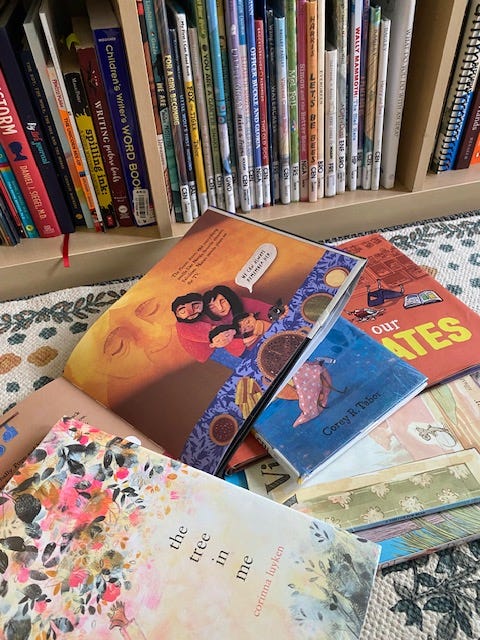
Here are a couple of picture books I’ve enjoyed this week that I’m happy to prescribe:
We Don’t Eat Our Classmates by Ryan T. Higgins
Effects: laughter, tenderness, surprise
Archetypes: The Jester / Fool (wacky, absurd humor), The Mother (tenderness and safety), The Righteous Outlaw (embracing the oddball and navigating social awkwardness)
Fox at Night by Corey R. Tabor (technically an Early Reader, but it has a boatload of great illustrations, so I’m sharing this as a picture book worth squirreling away)
Effects: suspense, curiosity, surprise, laughter
Archetypes: The Trickster (playful mischief and delight), The Sage (curiosity and learning from the world), The Guide (gentle accompaniment into shadowed or suspenseful moments)
I’d love to know what’s in your picture book apothecary. What specific medicines do they hold for you? Feel free to share titles and the names of the authors and illustrators who spark a sense of aliveness in you, those that gently nudge you back into alignment with Life.
Adult: 18 y/o? 21 y/o? After the brain fully forms, around 25-27 y/o? I think this might be one of those topics of “debates about matters of consequential business!”
Joanna Macy describes The Great Unraveling as “an ongoing collapse of living structures. This is what happens when ecological, biological, and social systems are commodified through an industrial growth society or “business as usual” frame. I like the term “unraveling,” because systems don’t just fall over dead, they fray, progressively losing their coherence, integrity, and memory.”
Joanna Macy describes The Great Turning as “the story of the global transition from the Industrial Growth Society to a Life Sustaining Society. It’s a story of great courage, in which much has been lost, but much is saved and creativity abounds. This story is being vibrantly lived today.
In the Great Turning, the wisdom of Indigenous traditions and ancient spiritual practices helps us understand and experience the inter-connectedness of all life. Attitudes shift from exploitation to respect, from extraction to regeneration, from competition to cooperation.”
The late community activist and Congressman John Lewis spoke about Rosa Parks: “She inspired us to find a way, to get in the way, to get in what I call good trouble, necessary trouble.”